
Tag: Retirement
-
Can Trump Accounts and Superannuation Help Us Afford the Future?

President Trump recently announced a donation of $6.25 by Michael and Susan Dell to kick-start new investment accounts, dubbed “Trump Accounts,” for 25 million qualified American children under 11 years of age. Trump Accounts were established as part of the One Big Beautiful Bill Act (OBBBA) and provide tax deferral for families with children.
-
Is Asset Location Strategy Worth the Effort?

Last week, we discussed the different qualities and benefits of pre-tax accounts like Traditional IRAs and 401Ks compared to Roth accounts. Since then, there were a couple of media discussions that go more into depth on the tax implications of asset location decisions. First, Merit Financial Advisor’s posted an excellent video breaking down the “problems”…
-
How Progressive Taxation Flips the Script on Investment Decision Making
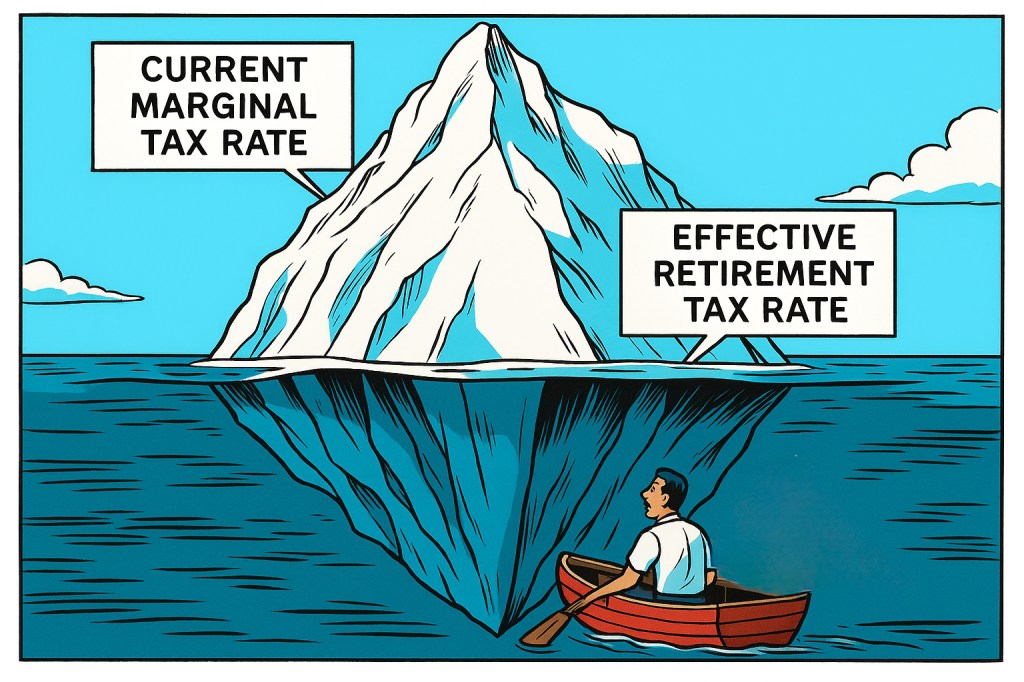
I started reading Sean Mullaney and Cody Garrett’s Tax Planning To and Through Early Retirement recently. I was happy to see Mullaney and Garrett break down the math behind Roth vs. Traditional accounts. Far too many financial planners and influencers use overly simplistic math, stoke fear about impending tax timebombs, or just cheerlead for “tax…
-
Is the Lifecycle Model Dead? New Research on Optimal Retirement Asset Allocation

Recently, I’ve been exploring optimal retirement asset allocations. Conventional wisdom suggests that savers should invest more conservatively as they approach retirement. The lifecycle model of investing, for example, posits that an individual’s investment strategy should change over their lifetime based on their age, financial goals, risk tolerance, and time horizon. During accumulation, investors typically have…
-
The Fetish of Financial Freedom: A Critique of the FIRE Movement

The Financial Independence (FI) or Financial Independence Retire Early (FIRE) movement presents a powerful and compelling vision of modern economic liberation. It offers an alternative to the 40 year career and the stress of living paycheck to paycheck. At its core, the movement promises a strategic escape from what some adherents describe as wage slavery,…
-
From Market Noise to Economic Footprint | Part 1

With the Magnificent 7 stocks now representing close to 35% of the S&P 500, it might be a good time to review how these indexes are composed. If you are in the Financial Independence (FI) community, you are most likely familiar with market capitalization (cap-weighted) indexing, an approach used in major benchmarks like the S&P…
-
The CAPE ratio, the Merton Share and Your Asset Allocation | Part 3

In the previous two articles, we teased the Merton Share as a rational framework for portfolio asset allocation. Now, let’s dive into how you can use both the CAPE ratio and the Merton Share to align your portfolio with your investing horizon, risk appetite, and current market valuations, without constant tinkering.
-
The CAPE ratio, the Merton Share and Your Asset Allocation | Part 2

Last week we discussed how the CAPE ratio of the S&P 500 is historically high at over 37, making the expected return on equities relatively low. And when we compare the earnings yield to the real return on 10-year TIPS, we see that the “equity risk premium” is quite small today. However, predicting the future is tough,…
-
The CAPE ratio, the Merton Share and Your Asset Allocation | Part 1

If you’re part of the Financial Independence (FI) community, you’ve probably built your retirement dreams on a pretty common assumption: stock market returns average 8–10%. To be fair, the S&P 500 has delivered, hitting a 10.2% compound annual return from 1928 through 2024. Popular FIRE calculators like Networthify err on the conservative side and dial…
-
Here’s How Much You Really Need to Save for Retirement

Planning for retirement spending is one of the more nuanced parts of financial planning. The Financial Independence community commonly follows the “4% rule,” which was first developed by Bill Bengen in a 1994 paper and later expounded upon in the Trinity Study. The 4% rule dictates that a properly designed portfolio should last at least…
 Fictitious Capitalist