

And What It Means for Your Portfolio
Short post this week with a discussion about stock market performance. I was recently working on an asset-liability matching exercise for my financial plan. Asset-liability matching is exactly what it sounds like: a financial strategy where you match your investment assets (stocks, bonds and cash) with your liabilities (debts and spending).
The core idea is to match the timing of cash needs with asset liquidation or income, minimizing the risk of interest rate fluctuations and inflation. This can be done by balancing the “duration” of assets and liabilities. My initial thought was to use bonds that match my liabilities over the short term, with stocks for discretionary expenses and longer term liabilities.
But how long is “long term” when you are talking about the stock market? Five to ten years is probably too short a time-frame for equities, but above 10 years, it gets fuzzy. Stock duration itself is a debatable concept, and it often gets pegged between 20 and 30 years.
Rather than using a fuzzy estimate of duration though, I started by asking “What is the longest amount of time stocks have underperformed bonds?” This is more or less the same question Meb Faber asked his Twitter followers:
Certainly, a liability 30 years from now should be covered by equities right? Maybe, but I was frightened by charts like this of 10-year Treasuries outperforming stocks over a 27-year timeframe:
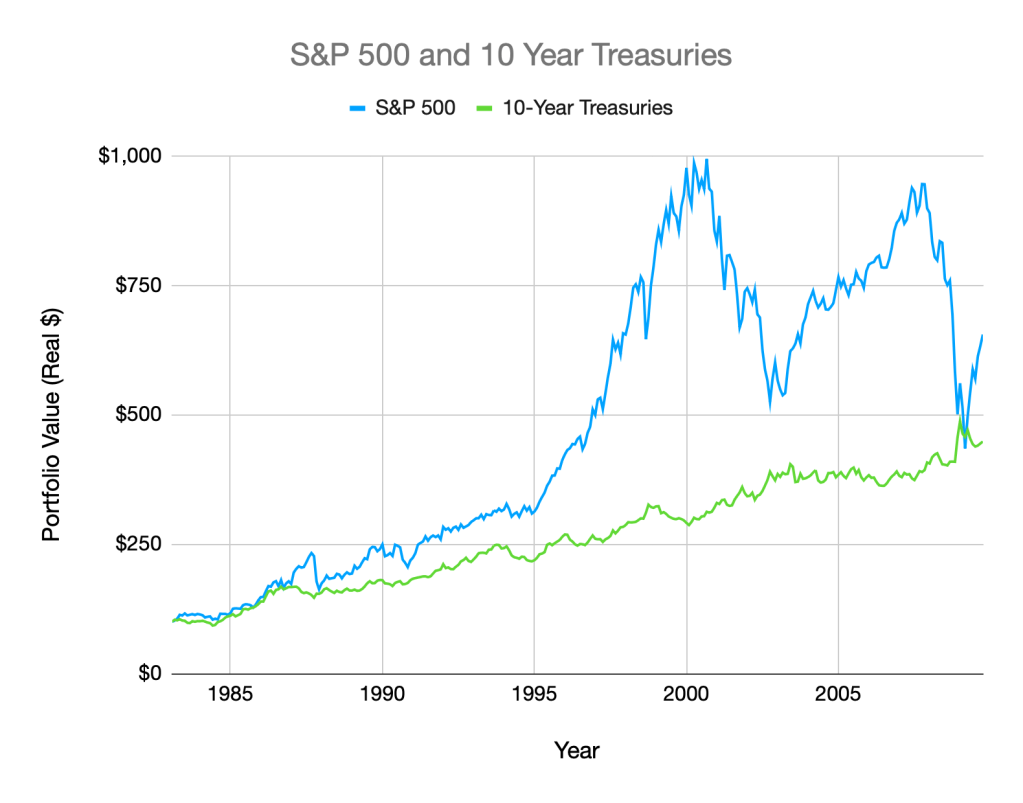
Stocks underperformed bonds for a brief period ending in early 2009. If you had bought in 1983 and sold in 2009, you probably would have been better off in stable 10-Year Treasuries. In real dollars (inflation-adjusted), this is the longest period of underperformance going back to 1861.
But the more I thought about it, the more I realized that it is not the situation I should be worrying about.
Instead, I want to know, given that I already own stocks, should I exchange them for more stable bonds? Whether or not stocks could end up underperforming bonds at some point 30 years from now is irrelevant to this decision. What is relevant is the shortest holding period from any given starting point that would have guaranteed a better return than bonds. In other words, it is the longest amount of time it would take to reach parity during a bear market.
These two situations sound similar at first, but they are very different. To demonstrate, take a look at the following chart:
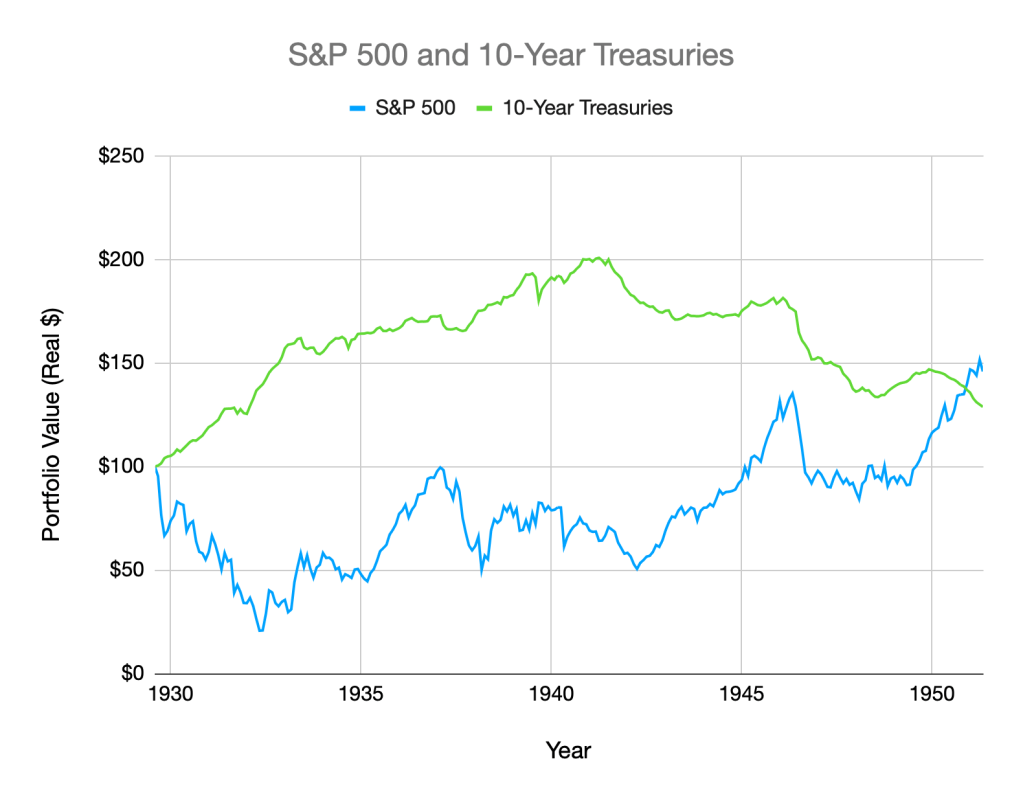
Instead of showing the maximum amount of time during which stocks underperformed 10-year Treasuries, it shows the amount of time it took for stocks to outperform 10-year Treasuries in the worst case scenario. Again, this is the worst performance for the S&P going back to 1861, but it is 22 years, not 27.
Note that in the first chart, stocks spend most of the time above bonds, dipping below only occasionally. In the second, Treasuries dominate stocks for all but the beginning and end of the chart.
So, how are these charts useful?
Arguably, the first one isn’t very helpful for liability matching unless you plan on directly funding a liability 27-years in the future with a stock investment. Even then, the period of underperformance was brief. You would have needed to sell during a small window of 1-2 months to realize the loss. On the other hand, you could have sold at multiple points along the way between 1981 and 2012 and been fine.
The second chart is more useful for the decision to exchange stocks for bonds. When you are selling stocks, you are derisking, attempting to avoid the worst drawdowns. You want to know how long it could take stocks to outperform bonds, so you can derisk into bonds for any holding period shorter than that.
Bottom line: History isn’t always the best indicator of future returns, but in many cases it is a good yardstick for risk. The fact is that there can be long stretches of time where the stock market underperforms bonds, but 30 years is probably too long and the 1983-2009 example isn’t very relevant for most investors.


You must be logged in to post a comment.