

This is the third part in a three part series on Environmental, Social and Governance (ESG) Investing. You can read Part 1 here and Part 2 here.
In the previous two posts, we explored how ESG became a worldwide phenomenon, how it courted political controversy and generated critique from politicians, armchair economists and academic journals.
While ESG investing presents a veneer of progress and responsibility, a deeper analysis reveals its fundamental limitations and inherent contradictions. Far from being a solution, ESG is a symptom and a perpetuator of the very problems it purports to address. In this final post, we’ll explore some deeper critiques through the lens of Marxist economics and offer some potential social democratic and market socialist alternatives to ESG that would produce more impactful outcomes.
Fictitious Capital: The Illusion of Productive Investment
ESG investing, particularly in public markets, largely deals with what Karl Marx called “fictitious capital.” Stocks and bonds represent not an investment in real productive assets like labor, technology, or machinery, but rather a claim on future profits. In secondary markets, investors are typically purchasing these claims from other investors, not injecting new capital directly into the companies themselves. This means that value flows from the productive capital, through the fictitious capital, to the investor, and not the other way around. The market value of fictitious capital is governed by expected future cash flows and speculation, often bearing only an indirect relation to real production.
The limited real-world impact of secondary market ESG investing, as discussed earlier, underscores this fundamental disconnect between financial speculation and productive economic activity. This detachment of the financial system from the real economy highlights a core aspect of Marxist theory: the tendency for capital to “double itself, and sometimes treble itself” through various forms of claims on the same underlying value, leading to an accumulation of claims that differs from actual accumulation. This can lead to asset inflation that bears little relation to the actual productive value of the underlying commodity, a phenomenon that, as Cedric Durand writes, can assume “proportions incompatible with the real production potential of economies,” inevitably leading to crises. The financial system, driven by the logic of fictitious capital, can create a “soap bubble of nominal money-capital” that, when it bursts, reveals that the nation did not grow poorer in real terms, but merely saw the nominal value of these claims wiped out. The financial system, rather than serving as a direct mechanism for societal steering, becomes an arena for speculative accumulation, with limited capacity to fundamentally reorient productive activity towards social or environmental ends.
Greenwashing as a Systemic Imperative, Not Just Deception
From a Marxist viewpoint, ESG is not merely susceptible to greenwashing; it is, in many ways, a form of greenwashing itself, driven by systemic pressures. Businesses primarily use ESG to improve their brand image, generate positive public relations, and raise capital. While individuals within firms may genuinely possess good intentions, the overall effects are often performative, designed to create an appearance of sustainability rather than enacting profound change. The net impacts of ESG investing, especially in environmental terms, are dubious. Companies might shift emissions to other industries or improve efficiency without reducing overall consumption, appearing “green” on paper while the broader system continues to be more extractive and polluting. Greenwashing, in this context, is not an anomaly but a logical outcome of a system that must appear sustainable to maintain legitimacy and attract capital, even as its fundamental logic remains unchanged. It involves the use of “false or misleading claims and symbolism” to convey an impression of commitment to environmental protection and sustainability.
This perspective, articulated by Joe Williams, argues that greenwashing is not just about individual “bad actors” but is “central to the (dis)functioning of contemporary capitalism”. It serves to obscure the socio-ecological relations inherent in commodity production, creating a “mirage or veneer of acceptability.” This obfuscation allows capital to continue its accumulation process while appearing to address crises, thereby deflecting genuine systemic critique and delaying necessary structural reform. The economic drive for growth, inherent in capitalism, is associated with alarming symptoms of environmental destruction and social demise. Greenwashing, by fetishizing socio-environmental spoilage and sublimating it into desirable images and exchangeable values, stunts the capacity for critical thought and political action. Even now, as ESG has become political anathema, it is trying to reinvent itself, claiming that perhaps a different investing framework will coax the markets to do better.
Capitalism’s Inherent Incapacity to Solve Systemic Crises
A core tenet of the Marxist critique is that capitalism, by its very nature, is ill-equipped to address systemic issues such as wealth inequality, global environmental destruction, and resource depletion. These problems are not external failures of the market but inherent to capitalism’s fundamental drive for endless accumulation and profit maximization. Capitalism creates problems, such as environmental degradation and inequality, that it then attempts to “solve” through market mechanisms like ESG. However, because the system’s core logic remains unchanged, these “solutions” are often fragmented, contradictory, and ultimately insufficient, as they cannot transcend the profit motive that drives the initial problems. In a capitalist system, even ostensibly “socially responsible” investments must ultimately justify themselves on financial grounds. If ESG does not deliver competitive returns, its market viability and widespread adoption are inherently limited. This exposes the underlying capitalist logic: social good is secondary to, or must be derived from, profit. This reinforces the idea that ESG operates strictly within the profit-driven logic of capitalism. It is not a challenge to that logic but an attempt to find new ways to generate profit or manage risk through social and environmental lenses.
From this perspective, personal investment choices, including those made through ESG funds, will never fix these problems because they require a collective response that transcends the logic of individual market transactions. The market has demonstrably failed in addressing these challenges, and market forces alone cannot protect the social and environmental foundations of society. The pursuit of profit often necessitates practices that are ecologically irrational, leading to a systematic tendency to overexploit the natural resource base. Beyond ESG, attempts to “design out” the tension between profitability and sustainability will likely fail, because this contradiction can only be addressed by confronting capitalism itself.
The Depoliticization Trap: Sapping the Will for Collective Action
Perhaps one of the most insidious aspects of ESG from a Marxist perspective is its role as a “depoliticization trap.” It saps the will and focus of otherwise well-intentioned people by allowing them to believe they have “done their part” by putting their money in an ESG fund, rather than demanding fundamental change from political and economic leaders. In this sense, it serves as a distraction from the concentrated power that directs policy and capital decision-making. By framing systemic issues as problems solvable through individual consumer or investor choices, ESG defuses collective political energy and reinforces the status quo. It reflects how weak and distracted our political conversation has become, reducing complex collective, democratic processes to mere personal consumption or investment choice.
This process of depoliticization is crucial to maintaining the capitalist system. As Francisco Valenzuela and Steffen Böhm argue, when socio-environmental spoilage is fetishized, any critical impulse in the consumer gets repressed. The offering of “green” sustainable commodities, even those with a “zero-waste” gloss, paradoxically arouses a “fetishistic desire to consume them more intensely.” This means that ESG, rather than encouraging a critical stance against the capitalist economy, upholds a false harmony that legitimizes and depoliticizes unsustainable human and environmental waste. It individualizes responsibility for change, obscures structural violence, protects powerful actors, and maintains the status quo. The moral argument for ESG, while seemingly benign, can inadvertently individualize systemic problems and provide a sense of “doing one’s part” without prompting a demand for systemic change. This ultimately diverts attention from the need for a collective response that challenges the very foundations of the capitalist system.
Beyond Voluntary Commitments and Greenwashing
ESG investing, while presented as a progressive force capable of reconciling profit with purpose, ultimately operates within and reinforces the fundamental logic of capitalism. It has demonstrated some capacity to lower the cost of capital for certain firms and offers a moral outlet for individual investors. However, these benefits are often contingent on market perceptions and are absorbed into the system’s inherent drive for accumulation and risk management.
The analysis reveals that many popular critiques of ESG are superficial, failing to grasp the deeper systemic issues. More sophisticated conventional critiques, however, expose genuine limitations: the indirect impact of secondary market investing, the mixed evidence on superior returns, the profound lack of standardization, and the inherent conflicts among environmental, social, and governance priorities. These limitations are not mere technical glitches but symptoms of a more profound incompatibility.
From a Marxist perspective, ESG is fundamentally constrained by its embeddedness within a system driven by fictitious capital and the relentless pursuit of profit. Greenwashing, rather than being an isolated ethical failing, emerges as a systemic imperative for capitalism to maintain legitimacy while continuing its extractive and exploitative practices. The core contradiction lies in capitalism’s inherent incapacity to resolve the very crises—environmental degradation, social inequality—that it generates. By framing solutions as individual investment choices, ESG inadvertently acts as a depoliticization trap, sapping the will for collective action and distracting from the concentrated power structures that perpetuate these problems.
Ultimately, ESG investing cannot fundamentally alter the trajectory of a system whose core logic necessitates endless growth and accumulation, often at the expense of planetary and social well-being. Genuine solutions to the escalating environmental and social crises require a transformation that transcends market-based mechanisms and challenges the very foundations of capitalist production and distribution. This necessitates a shift from individual investment choices to organized political and economic action aimed at subordinating the market to democratic will and prioritizing social and ecological needs over private profit.
Instead of relying on the illusory promise of “green capitalism,” a truly transformative path demands a re-imagining of economic structures themselves. Aligning the economy with environmental and social objectives requires strengthening existing democratic institutions and building new ones. While the list below isn’t exhaustive and each will not work alone, they would certainly accomplish more than ESG ever hoped to:
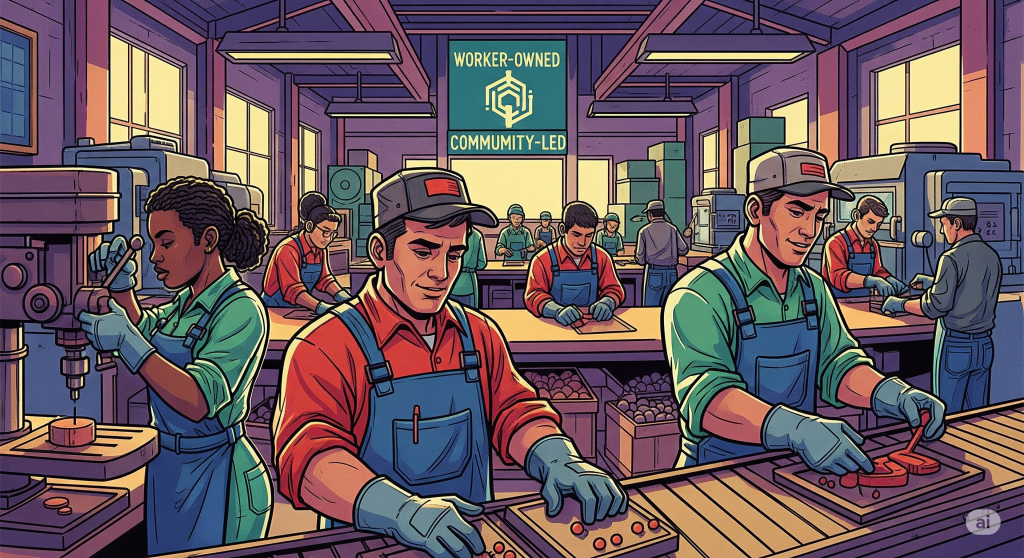
- Cooperative Economics: Fostering and prioritizing enterprises owned and controlled by their workers or communities, where profits are reinvested for collective benefit or distributed equitably, rather than extracted for private shareholders.
- Social and Sovereign Wealth Funds: Establishing publicly owned investment vehicles that manage capital for the long-term benefit of all citizens.
- Mutualized Investment Companies: Developing investment structures where fund investors, rather than external shareholders, own and govern the entity.
- Civilian Labor Corp / Job Guarantee: A government-sponsored Civilian Labor Corp in the mold of the Works Progress Administration (WPA) programs from the 1930s could provide a job guarantee to Americans while focusing on critical areas like environmental protection that remain unaddressed by the private sector.
- Cooperative Banking / Credit Unions: Strengthening member-owned financial institutions that prioritize community development and ethical lending over maximizing private profit.
- Regulation and Enforcement: Forming and enforcing strict regulations to ensure environmental, civil and worker rights are protected and criminal penalties are levied against business executives and majority shareholders who violate them.
- Limiting Corporate Charters: Ending corporate personhood and reimposing limited and conditional corporate charters similar to early U.S. history.
- Anti-Trust: Stronger anti-trust law could set an upper limit on firm size. Companies that grow above the limit could be broken up, turned into worker cooperatives or nationalized.
- Democratic Reforms: Implementing direct democracy through national ballot initiatives, banning Congressional stock trading and implementing term limits, campaign finance reform, ending gerrymandering, and holding national elections for Supreme Court justices.
- Nationalization / State Ownership / Municipalization: Bringing essential services and key industries such as energy, health care, and banking under direct public or municipal control.
These collective solutions represent a fundamental departure from the market-centric approach of ESG. They aim to build an economy where social and ecological well-being are not externalities to be managed or greenwashed, but intrinsic goals embedded within the very ownership and governance structures of production and finance. This is the path toward a sustainable and equitable future, one that moves “beyond the green veil” to confront and transform the underlying contradictions of capitalism.
 Fictitious Capitalist
You must be logged in to post a comment.