

Energy efficiency may be boring, but it can be an incredibly lucrative investment
What if I told you there is a way to make a 20 percent annual return on your investment over the next 13 years? What if I also told you that you could make that return with the same low risk associated with U.S. Treasury bonds?
No, I’m not talking about crypto or the latest alternative investment. It also doesn’t require millions of venture capital or any specialized knowledge or connections either.
I’m talking about a piece of technology called a Heat Pump Water Heater, sometimes called a Hybrid Electric Water Heater. It looks a lot like a standard electric water heater that you might have sitting in your garage right now.
Heat pump water heaters function a lot like a standard water heater, but with a heat pump attached to it. The heat pump collects heat from the air surrounding it and dumps it into the water heater, while a backup electric anode rod ensures that your water heater keeps up with your household’s needs.
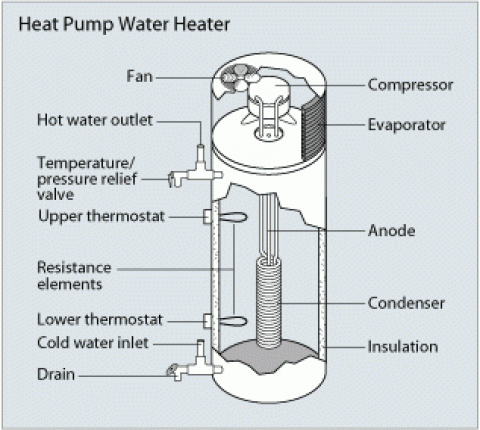
This heat pump technology is more than three times as efficient as electric resistance found in common electric water heaters. All that efficiency means a lot less energy is used to heat your water. And since the Department of Energy estimates that about 20 percent of the average home’s energy is used to heat water, installing one of these systems could save you a lot on your energy bills.
How much, you ask?
Heat Pump Water Heater Calculator
To estimate savings, I created a Heat Pump Water Heater Calculator Google Sheet. The calculator requires inputs like the cost of electricity, the expected rate of inflation, the current age of your water heater, and the cost of purchasing both a new standard electric water heater and a new heat pump water heater.
I provided links and resources in the calculator to help you estimate your inputs. For some inputs like the cost of purchasing a heat pump water heater, you’ll need to do some research. You might want to receive a few quotes from contractors, or check out DIY options through Home Depot, Lowes or your local plumbing supply company.
Here is a brief description of the inputs to the calculator. I also included comments in the Google Sheet to help you estimate your inputs.
- Electricity costs (16.5 cents per kWh) are a taken from a nationwide average of electricity costs as referenced by the Bureau of Labor Statistics.
- The energy inflation rate is the amount that you expect electricity rates to rise per year. The default, 3.5 percent, is roughly the average inflation rate over the last 90–100 years.
- Most water heaters have a wattage between 4,000 and 5,500 watts. You can check the nameplate/label on your water heater to find yours or search for the model number online.
- The age of your current water heater can be estimated if you don’t have an exact date. The higher the number, the more “fully depreciated” your water heater is, which lowers the first year costs.
- The uniform energy factor (UEF) is a measure of equipment efficiency and is usually posted on the water heater’s label or nameplate. If you have an older water heater, it may be labeled with the energy factor (EF), which can be used as a stand in for UEF in these circumstances. A typical electric water heater will have a UEF of around 0.90, but generally not more than 1. A new heat pump water heater’s UEF will be between 2.5 and 4.0. Again, you can ask your contractor for this information or check online.
- The cost of the installed equipment should be entered into the cost fields based upon your contractors’ estimates. If you are DIYing it, you can just include material costs. Don’t forget that these costs often include more than just the cost of the water heat itself, so be sure to investigate what other materials you may need for the installation. I’ve included some estimated costs ($1,500 for a standard electric water heater; $4,000 for a heat pump water heater) in case you aren’t ready to get quotes.
- The Federal tax incentives for heat pumps just went up! You may be eligible for a 30 percent tax incentive up to $2,000 as of January 2023 for qualified heat pump water heaters. This calculator estimates your tax incentive for you, but you’ll want to check with your tax advisor to make sure you qualify.
- State, local or utility rebates may be available for your heat pump water heater. You can check www.dsireusa.org for a list of qualifying rebates and inquire with your electric utility to see if they offer incentives.
- During the life of the heat pump water heater, it will generate electric bill savings that can be invested into either bonds or stocks or taken as cash. The typical lifespan of a water heater is about 13 years, so the calculator assumes you will invest the cash flow every year during that period. The calculator assumes bonds pay approximately 4 percent annually and stocks 8.5 percent.
- Ground water temperature is critical for estimating your savings. The colder your average groundwater temperature, the more your water heater has to work to deliver hot water. You can take a look at the map provided in the Google Sheet to estimate your average ground water temperature.
- Hot water temperature is highly subjective. The most efficient temperature that is still safe is 120 degree F, but many people prefer to set their hot water heater higher. Check your current hot water temperature and input that into the calculator.
In the example below, I perform a cost-benefit analysis for a typical home with four family members located in Atlanta, Georgia. You can use my figures to demonstrate the savings or input your own depending on where you live and other factors. Here is a snapshot of the inputs:

For our family of four in Atlanta, Georgia, I assumed a slightly older existing electric water heater with a UEF of 0.90. The average ground water temperature in that region is around 65 degrees according to the map in the calculator.
Results and Growth Potential
In our example, the family installed the new heat pump water heater and committed to reinvesting their savings over the next 13 years in an intermediate term bond fund with a 4 percent annual return on investment. So, how did the family make out?

How did they end up with over $15,000 in their account from one water heater? Well, here is an explanation of the results:
- The annual operating costs for a heat pump water heater are $258.95 or nearly $750 less than the operating costs of a standard electric water heater.
- The payback, or the measure of the amount of time it will take to make back their investment, is slightly less than 2 years. The reason this is so low, is partially because the installed cost ($4,000) is reduced by the tax incentive ($1,200) and utility rebates ($500), It is also only fair to compare the “incremental” cost (about $1,356) of the heat pump water over a standard electric water heater, since the family would probably need to replace it soon anyway (likely within 3–5 years).
- The lifetime net cash flow ($10,698.08) is the amount of savings generated by the heat pump water heater over its 13 year life.
- The internal rate of return (58.45%) is a useful way of comparing investment opportunities, but doesn’t tell you much about the total return on your investment. If you could take the cash flow and reinvest it back into the project, it would provide a compound annual return equal to the internal rate of return. Unfortunately, there is no way to do that unless you have an endless supply of houses waiting to be retrofitted with heat pump water heaters.
- The compound annual growth rate (20.39%) is the effective annual rate of investment growth if the family invested all the savings into an intermediate U.S. Treasury bond fund as planned.
- The ending portfolio balance ($15,129.02) is just that: the amount the the family would have in their Treasury bond fund at the end of the heat pump water heater’s expected useful life.
So, the family effectively took a $1,356 investment (the incremental cost of the heat pump water heater) and turned it into $15,129 account in 13 years, an annual compound growth rate of over 20 percent. Not a bad rate of return for a relatively low-risk investment strategy!
To push this a little further, I calculated the compound annual growth rate and ending portfolio balance for various scenarios, assuming a different number of individuals in the household and different investment strategies. The results of these calculations are shown in the table below:

The compound annual growth rate and final portfolio balance increase significantly if more individuals are living in the household. That is because energy consumption is higher and thus energy savings potential is also higher.
If you choose to invest the savings in a riskier but more profitable stock fund, the earnings potential is higher but not by nearly as much as you’d expect — the difference between cash and bonds, for example is only around 2% annually. That is because most of the growth is driven by the heat pump water heater itself, not what you do with the savings.
In some cases, the growth can be so high and the payback so quick that a heat pump water heater could be seen as a good income generator for folks nearing retirement. When it comes to utility bills, reduced spending is effectively the same thing as increased income, especially if there is no discernable impact on your lifestyle or comfort.
Some caveats and reasons it might not make sense for you
Despite the incredible math behind them, heat pump water heaters are not always ideal for every household or situation. The ENERGY STAR Program lists some important considerations you’ll want to review before making the switch. Here is a summary of factors that might help you decide whether a heat pump water heater is appropriate for your home:
- Heat pump water heaters tend to work best in warm climates. Colder temperatures may affect the performance and efficiency of your water heater and if installed indoors, can increase the heating load on your HVAC system. That extra heating load can negatively impact your overall cost savings and total home efficiency, making the calculator above inapplicable.
- In cooler climate, heat pump water heaters make the most sense in garage, basement or boiler room applications. If your water heater is currently in a closet or smaller conditioned space in your house, you may need to add ventilation or ductwork to ensure enough air volume, which could add to the costs significantly.
- Heat pump water heaters output cold air, which could be either a good or a bad thing, depending on your cooling and heating needs. This can lead to comfort issues, so be careful when installing it indoors.
- Heat pump water heaters make more noise than your average water heater. The noise is tolerable in my opinion, but might upset those who don’t like noisy appliances. There’s a good video online here comparing the noise to various other household appliance.
- Contractors aren’t universally familiar or comfortable with heat pump water heater technology yet. You may have trouble finding installers in your area that have experience with them, but hopefully the updated tax credits will convince more of them to get on board. In any case, make sure the contractor you are working with knows what they are doing and understands the ventilation and condensate drainage requirements of the technology. (For this reason, you likely won’t want to wait until your electric water heater goes kaput to do the upgrade. Struggling to find a contractor while you family goes without hot water for days on end, is not a recipe for a good outcome.)
- The calculation doesn’t work if you have a natural gas water heater. Natural gas prices have historically been lower than electricity per BTU, and their prices fluctuate independently, so savings is not guaranteed. You also may need additional wiring or a panel upgrade, which could add to the cost of your project.
After all this, you might be surprised to learn that I haven’t yet installed a heat pump water heater in our home. Unfortunately, with our small house footprint (720 sq. ft.) and the location of the water heater (in our small laundry room), it won’t be feasible without significant ductwork and added expense. I’m not keen on ventilating the heat pump into our house because of the extra heating requirements in the winter, although a louvered duct system might be the right solution.
In addition, we recently installed solar PV and we’re still waiting to see how much of our usage is being displaced annually. There is no sense reducing our net usage below zero because our net metering agreement doesn’t allow it.
Based on these conditions, and our lower local electric rates in the Pacific Northwest, I estimate the projected compound annual growth rate to be around 7 percent — not terrible, but far short of the ideal. We’ll reevaluate our options when we get through a full year of solar generation and once again when our five-year-old water heater nears the end of its useful life.
This all underscores the need to do your research before assuming a big payoff from energy efficiency investments. But, if the conditions are right, your rate of return could be far greater than that of other investment options like stocks and bonds.

